Official languages: French, German and Luxembourgish
Capital: Luxembourg City
Currency: Euro
Population as % of total EU: 0.11
Joined EU: 1958
Did you know?
- Luxembourg is the second richest country in the world, beaten only by Qatar. The minimum wage in Luxembourg is € 1,998.60 per month, the highest in the EU.
- Covering an area of around 2,586 square kilometres (999 square miles), Luxembourg is one of the smallest countries in the world. It is also the least populated country in the EU, with a population of just over half a million people.
- In 2014, Luxembourg’s Prime Minister Xavier Bettel became the first European Union leader to marry someone of the same sex, architect Gauthier Destenay.
- There is only one university and only one casino in Luxembourg.
- Over 40% of Luxembourg’s total workforce commutes from another country, with the highest numbers coming from France, Belgium and Germany.
Visiting Luxembourg: exceeding expectations
Without this blog, going on holiday to Luxembourg would never have occurred to me. A few friends had visited the country for business, but no one seemed to have any recommendations and dedicated travel guides were scarce. This meant that my expectations were pretty low, and that I hadn’t really planned much of the visit in advance.
Surprisingly, this turned out to be a great way to visit Luxembourg – my expectations were roundly surpassed and every time we discovered something good, it was even more exciting than usual. Nevertheless, I’m still going to share some recommendations – as they might just give you the incentive to plan a trip for yourself.
We arrived in Luxembourg City on the train from Brussels. It was pouring with rain, but we still couldn’t resist having a bit of a walk around the city centre. The main square, Place d’Armes, became the backdrop of what might be my favourite photograph from the trip:

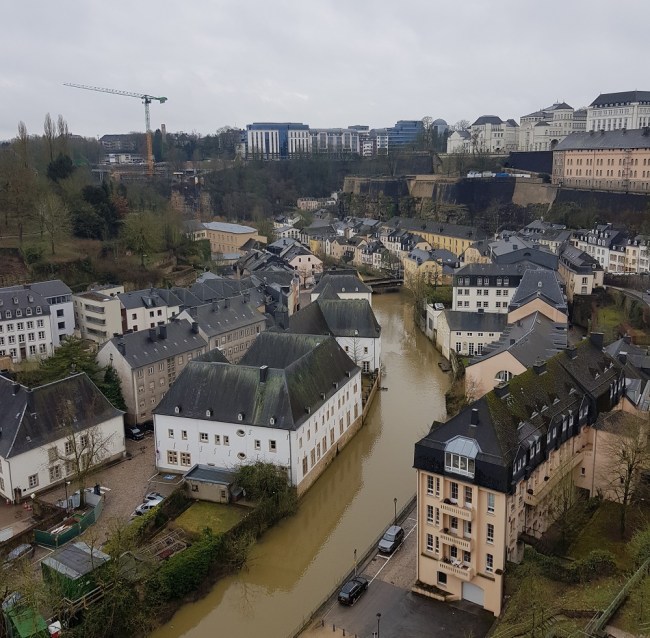
The city centre of Luxembourg City is compact and easy to walk around. The Petrusse Valley runs through it, and there are some rather stunning views to be had.
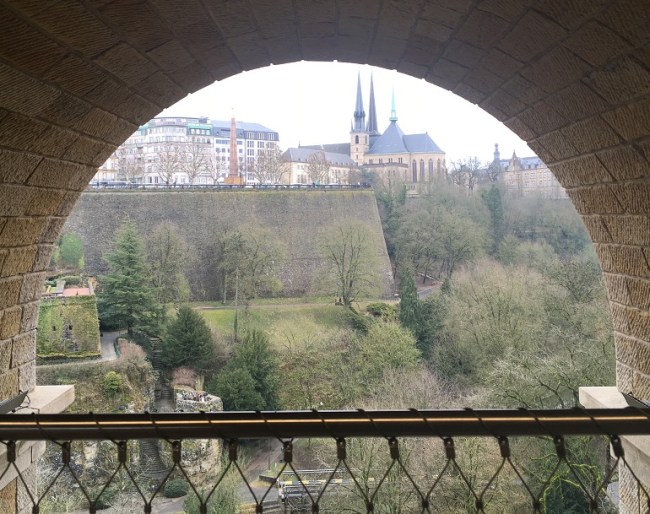
We spent our first day in Luxembourg taking in the views from both the top and the bottom of the valley, which is crossed by lots of different walking routes. There are some recommended self-guided tours that are clearly signposted (you can pick up maps from the tourist office), but we mainly wandered in whichever direction looked interesting.
Highlights included the Adolphe Bridge (a bridge with another bridge suspended inside!), the majestic Gëlle Fra (Golden Lady) war memorial, the Palace and a panoramic elevator that runs from the top of the valley to the bottom. A bit further afield is the striking Grand Duke Jean Museum of Modern Art (MUDAM), which has some stunning skylights that let light play beautifully over the exhibits.
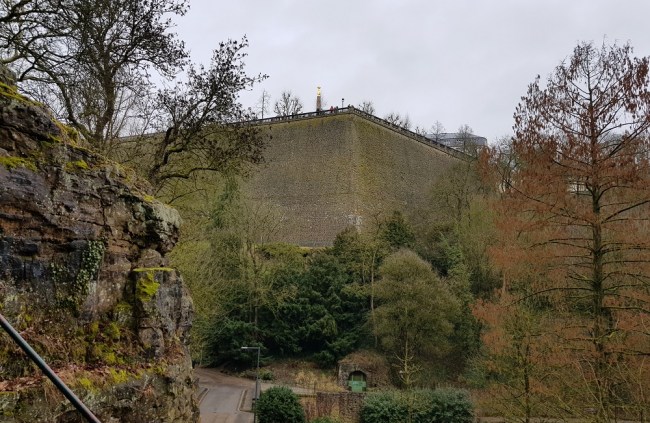
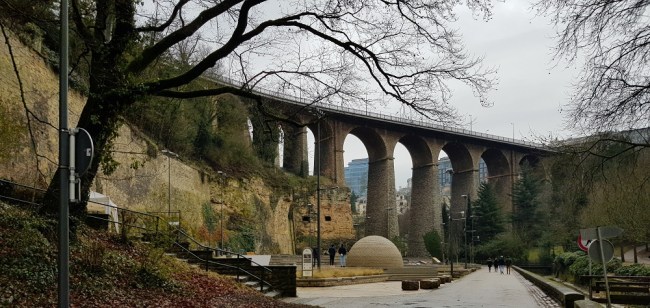
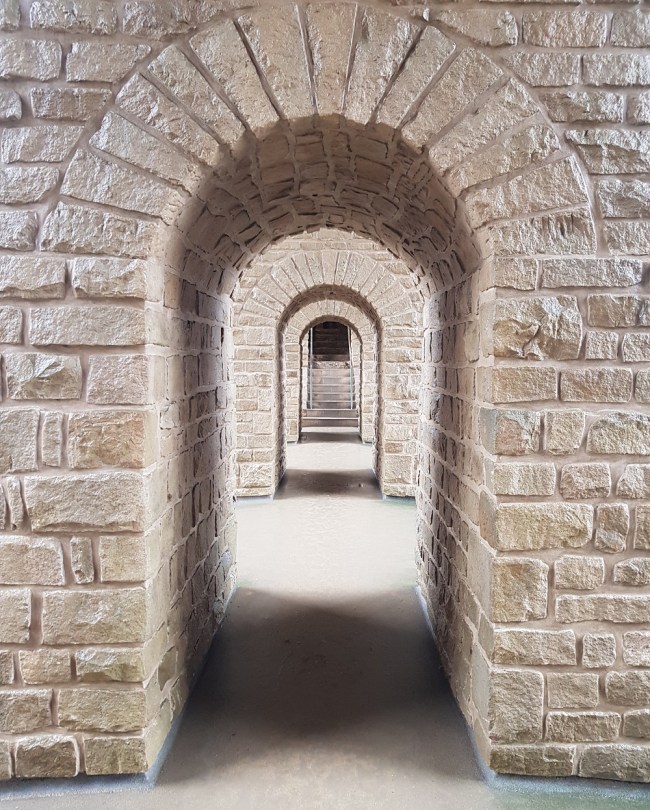
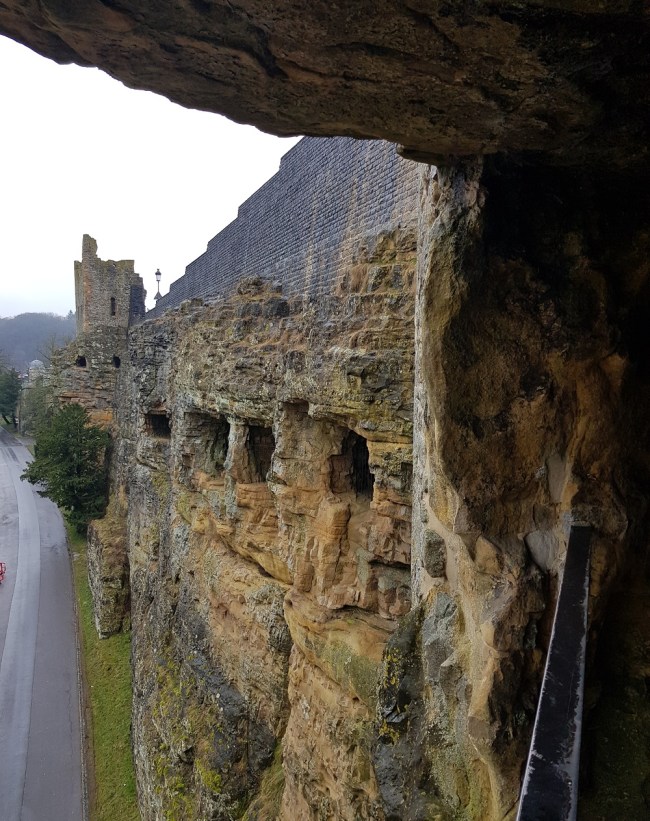
The Bock Casemates are also worth a stop (€ 6 entrance fee). The casemates (definition: fortified gun emplacements or armoured structures from which guns are fired) are the sole remnants of Luxembourg’s old military fortifications and were originally built in 963. You can wonder through their atmospheric, interconnecting tunnels and get a flavour of their long history – there’s even a strange mermaid connection to be discovered…
At the bottom of the valley you’ll find the Grund neighbourhood, which is picturesque and home to some lovely restaurants, bars and shops.
Eating and drinking in Luxembourg City
One thing we quickly discovered about the Luxembourgish capital is that it had excellent food options, and everywhere we went the portions were ridiculously generous. Our top five near the city centre:
- Mamacita: amazing Mexican style food and drink over two very quirkily decorated floors. Home of my first encounter with battered, deep fried avocado.
- Vins fins: words cannot explain how much we loved this wine bar in Grund. Small, cosy and run by a funny and charming couple, the food is very cheese orientated. Try the raclette or the fondue after prepping your tastebuds with a Luxembourgish crémant. The owners also have a sister restaurant, The Farm, in the Hollerich district of the city.
- Café des artistes: a pub in Grund, eclectically decorated with old posters and amazing drippy candles. At about 10 pm, all electric lights are turned off and a pianist starts playing old favourites by candlelight. By midnight, it’s standing room only and half the pub is singing along with gusto.
- Ready?! Coffeeshop: a great place for breakfast just outside of the city centre. Bikes adorn the walls, the bagels are delicious and there’s a distinctly local vibe.
- Chiggeri: a restaurant made up of many floors and many rooms, each decorated in a different style, but all equally crazy to look at. A good laid-back option where it’s easy enough to get a table. The tartiflette is about a million calories but crazily delicious.
Schengen
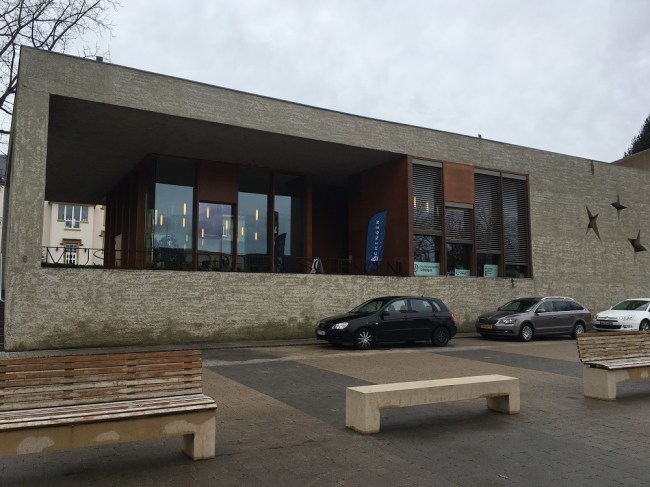
Schengen is a small town in the south of Luxembourg that borders both France and Germany. It’s where the Schengen Agreements – which abolished many of the EU’s internal borders – were signed, in 1985 and 1990. Today, it is home to the European Museum, about the history of the agreements and the EU more generally. It’s small but perfectly formed, and has a fantastic display of the passports issued by all EU and EEA countries.

What is perhaps less known about Schengen is that it sits in Luxembourg’s Moselle region, which is renowned for its wine. If you didn’t know Luxembourg had a wine-growing region, you’re not alone – it was news to me too.

A short, uphill walk from the European Museum you’ll find a lovely vineyard, Domaine Henri Ruppert. It has a small bar-restaurant overlooking the vines, where you can sample their delicious wines in an informal and friendly setting.

Getting around
Getting around Luxembourg is surprisingly cheap – you can buy a day travel ticket for buses across the whole country for a mere € 4. A single ticket is € 2, and both can be picked up from the ticket machines at many bus stops.
 All Around EU