“According to Greek mythology, humans were originally created with four arms, four legs and a head with two faces. Fearing their power, Zeus split them into two separate parts, condemning them to spend their lives in search of their other halves.”
― Plato (427—347 BC), The Symposium
Official language: Greek
Capital: Athens
Currency: Euro
Population as % of total EU: 2.1
Joined EU: 1981
Did you know?
- Presenting the palm of your hand to someone with all five fingers extended is considered an insult in Greece. The gesture, known as moutza, is very similar to waving, and so this form of greeting should be avoided when in the country.
- The word ‘tragedy’ has roots in a Greek word meaning ‘goat-song’ (from tragos meaning goat or buck and oide meaning song). There are many theories to explain this connection. One frontrunner is that, as early Greek tragedies honoured Dionysus (the god of wine, amongst other things), the players in them often dressed up in goatskins to represent satyrs, half-goat beings that are said to have worshipped and surrounded Dionysus in his revelry.
- Rivers in Greece are generally shallow and turbulent, making them excellent for watersports but practically unnavigable by boat. In fact, only two rivers in the country – the Evros and the Loudia – can be navigated by boat, but only in part.
- On the Cyclades islands, a group of over 200 outcrops southeast of the Grecian mainland, the majority of buildings’ doors are painted a particular shade of turquoise. The same shade can also be spotted on the islands’ cupolas, windows, staircases, fences and more. This isn’t a coincidence: there is an ancient belief that the colour wards off evil. This blue is offset by the startling white of the houses on the islands, the result of an old government decree constraining what colour buildings were allowed to be painted.
- Greece has been gripped by an economic crisis since late 2009. The country’s GDP has shrunk by over a quarter since 2008; nearly a quarter of its workforce is unemployed; over a third of children are classified as poor or nearly poor. The reasons for the crisis and its continuation are many and varied, but many claim they are closely linked to Greece’s use of the Euro. This connection is currently leading commentators to suggest that a ‘Grexit’ could soon be on the cards.
Visiting Greece: generosity and spirits
The late morning sunshine beat mercilessly down onto the pavement outside my hotel. By extension, it beat mercilessly down onto me. In an ideal world I would have ducked into the shade of the hotel lobby or some nearby trees, but I had been instructed to stand in a prominent position near the kerb. Someone was coming to pick me up for lunch with my father.
Unfortunately, I had no way of recognising this ‘someone’. All I knew was that they were male, Greek, in their mid-twenties and in a car. Thankfully, he had a little more to go on – he had met my father, and we look alike. Perhaps for the first time in my life I appreciated our family resemblance.
I peered expectantly at each car that went past. Perhaps a bad idea, but at 15 I was still too innocent to know any better. After a few false alarms, a beige vehicle slowed down and a young man leant out:
“Joanna?” he asked, heavily accented.
I smiled obligingly and nodded my head, clambered into the passenger seat. We exchanged a few pleasantries and then lapsed into a comfortable silence; I gazed out of the window. Stray dogs raced the car as I watched Thessaloniki slip by. The city centre petered out, gradually replaced by industrial units. We were approaching the port.
After driving through a combination of warehouses and shipping containers for a couple of minutes, we pulled up next to a unit with its doors open. A tall, thick-set man came through them. He was waving a fish and looked delighted to see us. We had reached our destination.
My father appeared next, looking equally ecstatic. Our dining companions for the afternoon were all family, a father and two sons. They greeted me as if I was another of their number, or an old friend. Not for the first time on this trip, I was struck by the openness and friendliness of the locals.
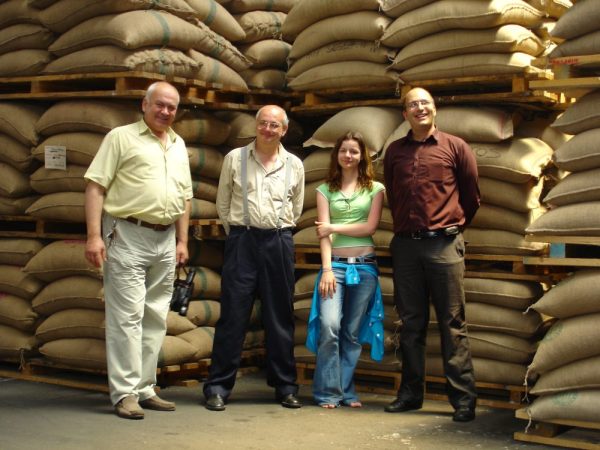
I had only really visited Italy and the Netherlands before; this trip to Greece came as something of an unexpected treat, a sudden invitation to accompany my father on a business trip. My father is a coffee broker, and these friendly men were people he worked with regularly. The warehouse was full of rich smelling (and better tasting) coffee beans, with a table set up near the adjacent office for lunch.
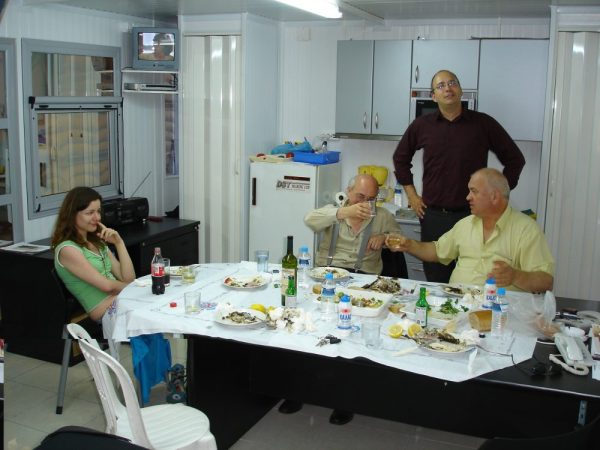
Lunch was bounteous: fresh fish and Mediterranean delights. But what I really remember, reflecting back on it eleven years later, is the atmosphere. For an extremely shy teenager to feel at ease with a group of garrulous men having a business lunch is quite a feat, and I believe it will stay with me even as the details begin to fade.
The next day, my father and I travelled to Khalkidhiki, a mountainous peninsula of northeast Greece, to meet another business acquaintance of my father. We were hosted by his wife and their two angelic children. These two, younger than me and yet closer to my age than anyone else present, regaled me with tales of their learning to roller-skate, innocently entreating me to fit my large, ungainly, almost-adult feet into skates that were much too small.
Again, the details are patchy and just an aura of the experience remains. The rest of the day is a series of impressions: waves lapping the shore; bobbing fishing boats; being driven back to the hotel in an open-top car; the wind running through my hair; David Bowie at full volume on the stereo; slowly drifting in and out of sleep along the journey.
As anyone who has visited my house will know, I always have a bottle of Ouzo in the cupboard. This Ouzo is made by the same man who hosted the lunch, and who continues to personalise the bottles for our family to this day. My trip to Greece was long ago, and the country has changed so much since. But my prevailing memory is of generosity and spirit – and I can only hope to return soon and appreciate it once more.
 All Around EU