Official language: French
Capital: Paris
Currency: Euro
Population as % of total EU: 13.1
Joined EU: 1958
Did you know?
- France is the largest country in the EU by area, covering more than 540,000 square kilometres.
- The first Cannes Film Festival was cancelled because of the outbreak of World War II. It was supposed to start on 1st September 1939 – the day Hitler invaded Poland. Though initially just postponed, it was eventually called off entirely with only one film (William Dieterle’s The Hunchback of Notre Dame) being shown. The festival was only revived 7 years later and was followed a shaky few years – but now it attracts upwards of 30,000 people each year, about 100 times the number of visitors in 1946.
- As a result of its numerous overseas territories, France uses 12 different time zones – more than any other country in the world. These territories are scattered across the Pacific, Atlantic and Indian Oceans (if you want to know them all: Guadeloupe, Martinique, Saint-Martin, Saint-Barthélemy, Saint Pierre and Miquelon, Reunion, Mayotte, the French Southern and Antarctic Lands, French Polynesia, New Caledonia, and Wallis and Futuna), cover almost 120,000 square kilometres and are home to more than 2.6 million people.
- In July 1830, Louis-Antoine of France, succeeded to the French throne when his father, Charles X, abdicated. However, he abdicated himself after 20 minutes, making him the shortest reigning monarch in history (alongside Prince Luís Filipe of Portugal).
- France has more roundabouts than any other country in the world.
Visiting France: ITS Strasbourg

Towards the end of June, I was given an amazing opportunity: to travel to Strasbourg and attend the ITS Europe Conference as a guest of the European Commission. Why? I had been chosen as one of 12 winners of the inaugural Transport Innovation Challenge.
The challenge invited 18 to 35 year olds from across the European Union to submit ideas for projects aiming to boost sustainable transport and mobility within the EU, and to propose solutions to difficult transport challenges. The ideas and solutions could be at any stage of development – from initial concept to trading business – but they had to be innovative, and they had to contribute to a vision of a cleaner and more efficient future for European transport.

My proposal (which was very much just at the initial concept side of the scale) was born out of my desire to raise awareness of the barriers people with reduced mobility face when making short, car-free journeys – on public transport or otherwise. According to the European Health and Social Integration Survey (EHSIS), in 2012 there were 70 million people aged 15 and over with disabilities in the EU, equivalent to 17.6% of that population – and it’s a mistake to think that these people don’t want to do and enjoy the same things everyone else does, be that sailing, travelling, bird-watching or chess.
My solution was simple, at least on the surface: a digital journey-planning tool specifically adapted for users with barriers to their mobility, be that people in wheelchairs, blind people, the elderly or just those who’ve broken a leg or have a big pushchair. A tool that could be added on to existing journey-planning platforms, allowing users to search for routes and modes easy for them to navigate, whether that means provision of dropped kerbs, hearing loops, textured paving or step-free access. The tool would also flag up common routes that users have problems with, highlighting them to the relevant local authorities or companies, advocating for improvement and change. Nothing fancy or gimmicky – just a tool to bring the power and utility of a really common facility to a group of people often left out. Convenience and advocacy in one handy package.
Of course, I know parts of this exist in various forms: in London, TfL and Moovit both have pretty good journey planning facilities for disabled travellers, for example. But I wanted to get more people talking about the issue, especially people within the transport industry – so this competition was an excellent opportunity.
And it almost goes without saying that it was also an excellent opportunity to be inspired by the ideas of others: from autonomous cleaning robots, chatbots for Italian ski huts to virtual reality cycling, the winning ideas spanned an impressive range of topics. We all had to present our ideas to an expert panel, and also at the European Commission’s stand at the conference: nerve-wracking, but a great way to learn and share ideas.
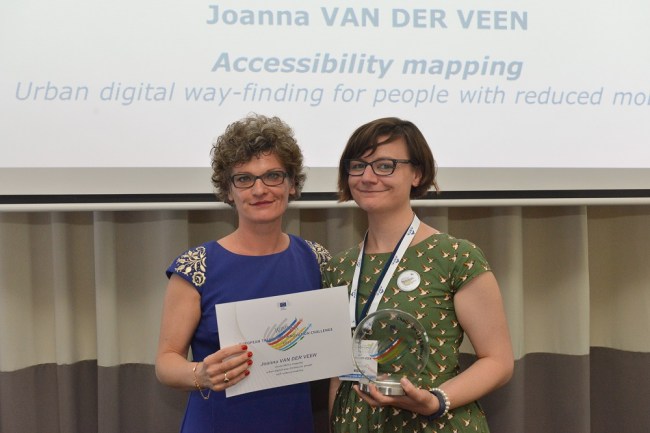
Although I could go on for pages, I’ll leave my conference thoughts there for now. But if this broad introduction has piqued your interest, you can read about all the winning projects here – and please do get in touch if you want to hear more.
Visiting Strasbourg: a few tips
I didn’t get much time to explore Strasbourg, but I tried my best to get a sense of the place. And it genuinely is a lovely city to just wander around – from the UNESCO-listed Grande-Île and Neustadt to the more austere and imposing buildings of the EU institutions. If you’re in town and have the time, I’d recommend just taking a day just to do this.

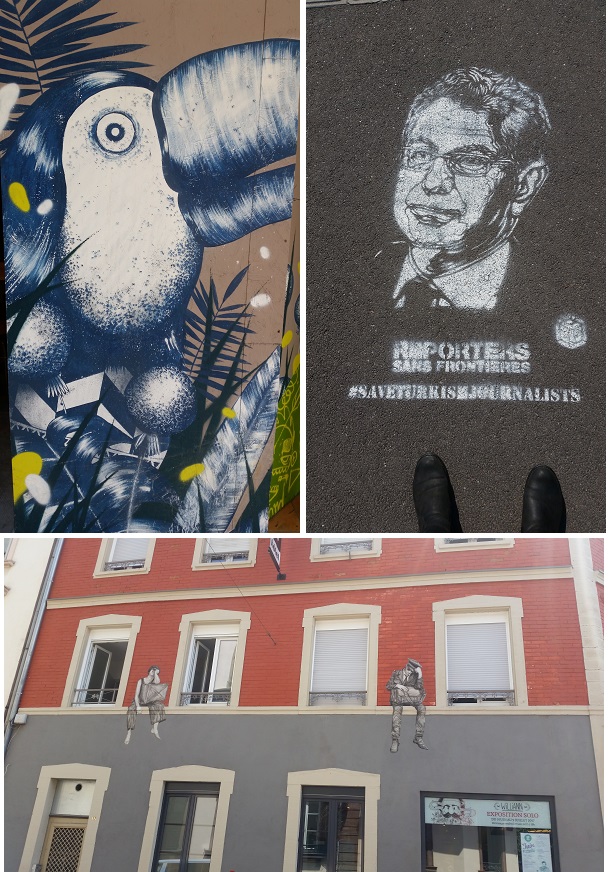
For the most part, I wandered aimlessly around the city centre – but I’d recommend making sure you take a turn around Petite France. While there, stop in to the Académie de la bière on rue Adolphe Seyboth for a beer and a gigantic portion of food.

The Cathedral is also stunning – have a peer at it in daytime and at night. You can also scale its heights and peer at Strasbourg from above if you time your visit right (I sadly didn’t).

Perhaps the coolest thing to do while in Strasbourg though? Walk to Germany! That’s right – Strasbourg is so close to the German border (and the town of Kehl) that you can cross a bridge straight into another country. The novelty of this might be lost on someone from mainland Europe, but it made me unreasonably excited. There’s a nice little waterfront promenade and some passable cafes once you get there – but the principle is the most exciting bit…

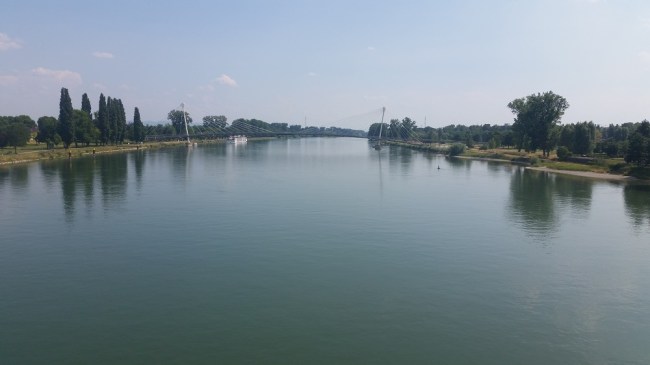

And what of food and drink? Unfortunately, French cuisine – though delicious, I’m sure – is not great for vegetarians. But fear not – in Strasbourg, semi-traditional options still abound! Dabble in the Alsatian classic of flammkuchen / tarte flambée (thin, crispy white pizzas with crème fraiche and lots of onion) and keep your eyes peeled for salads with ‘cheese toasts’ (especially if they have added cumin). Trust me, you won’t regret it.
 All Around EU